Blog
The Architecture of Movement
Did you know that something as simple as an escalator or pedestrian bridge can actually serve a larger purpose in the design of a city like Las Vegas?
The Strip is a carefully choreographed sequence of escalators, ramps, bridges, and corridors that help guide where you go, how fast you get there, and what you encounter along the way.
Movement is one of the city’s most effective design tools, influencing everything from foot traffic to spending behavior. Let’s look at some examples.
Escalators as Decision Points
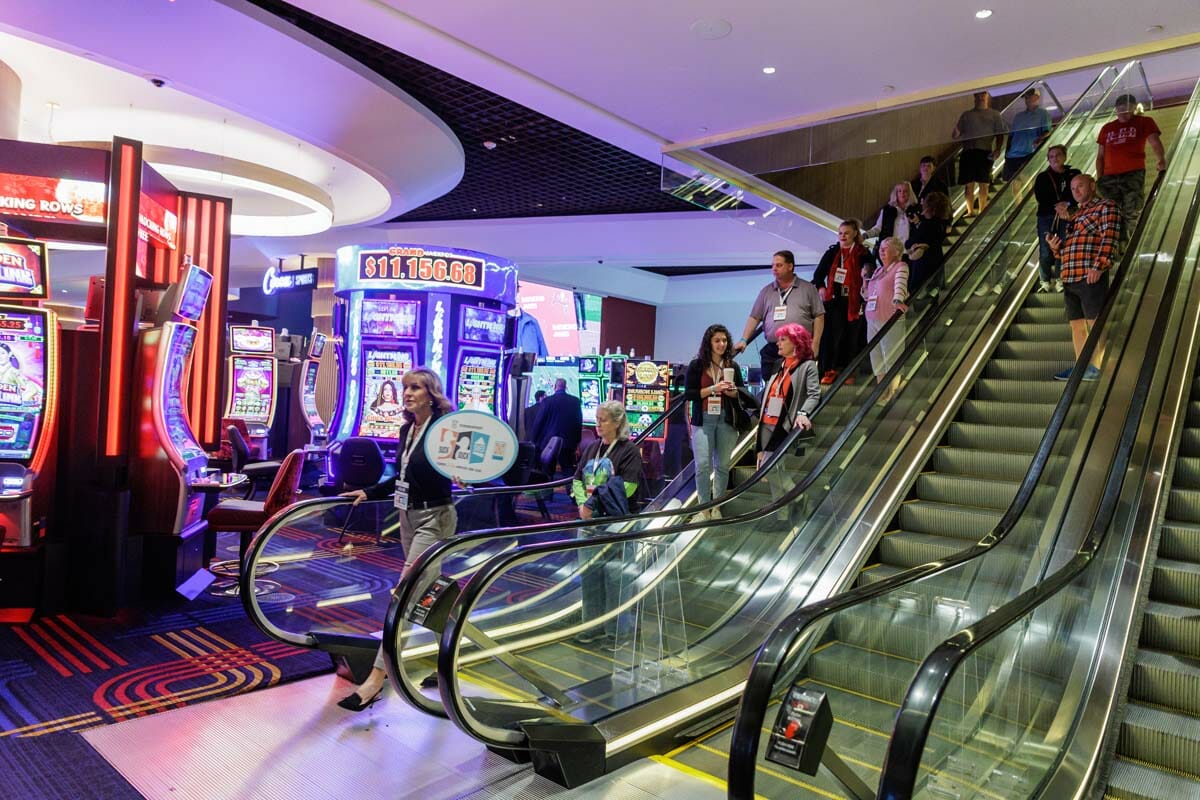
Escalators on the Strip are rarely just about getting you from point A to point B. They’re positioned at moments where a decision needs to be made.
Take the walk between Bellagio and Caesars Palace, along the Las Vegas Boulevard Overpass. Throughout the walk, you have to take an escalator that takes you up to the raised walkway. Then, when you come down the escalator, you’re blocked by a wall from the traffic, which also positions you conveniently on the resort property.
Throughout the whole way, you’re contained for safety, but also for maximum impact for staying within the properties.
Escalators also create micro-pauses because for 20 to 30 seconds, you’re suspended in place, facing forward, often toward a branded facade or a high-impact visual like the Fountains of Bellagio or shopping options. That pause increases exposure, and exposure increases the likelihood of engagement.
Skybridges That Turn Crossing Into Opportunity
In most cities, a pedestrian bridge is a utility. In Las Vegas, it’s real estate.
The pedestrian connection between New York-New York Hotel & Casino and MGM Grand is one of the clearest examples of movement being used to engineer cross-traffic.
On the New York–New York side, the experience starts with high-visual energy: the skyline replica, the roller coaster overhead, outdoor dining, and plenty of bars to stop at. As you move toward MGM Grand, the bridge positions you to pass directly by high-traffic retail before you re-enter the casino.
This is doing a few things at once:
- Capturing intent mid-journey: People crossing the bridge become potential customers for retail they didn’t plan to visit.
- Distributing traffic across properties: Instead of one resort holding attention, the flow is shared.
- Extending dwell time: What could be a 30-second crossing if there was a crosswalk on the street becomes a multi-minute experience that takes you from one high-intent spot to another.
In addition, many of these skybridges also have vendors set up to get more business. You’ll often see street performers, people in costume, and people trying to sell seats to shows, clubs, and restaurants.
Further south, the interior walkway connecting Mandalay Bay Resort and Casino to Luxor Hotel and Casino is climate-controlled and deliberately continuous. You can move between properties without ever stepping outside, which removes a major friction point in the desert climate.
These connections serve a few key purposes:
- They extend the “zone” of a resort beyond its footprint.
- They capture foot traffic that might otherwise stay on the sidewalk.
- They create shared ecosystems where multiple properties benefit from the same flow.
Instead of isolated destinations, the Strip becomes a network, and movement is what ties it together.
Strategic Pathways Inside Resorts
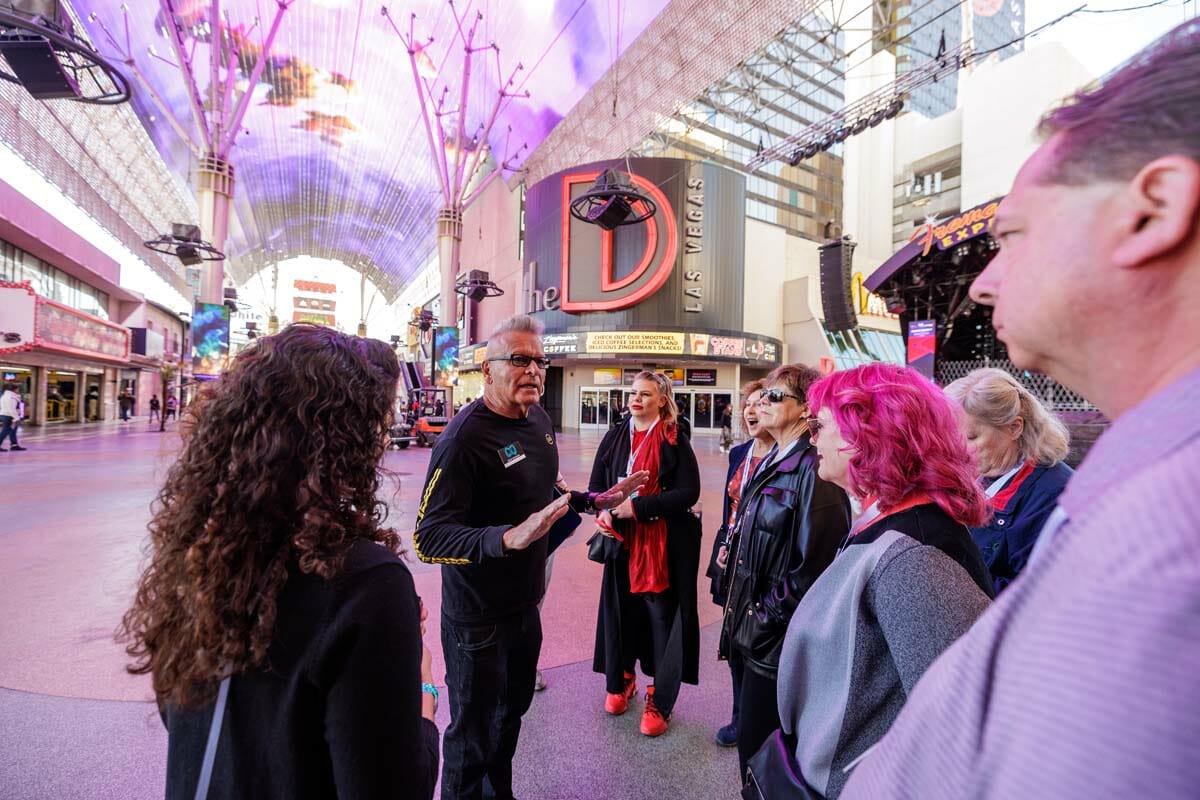
Some Las Vegas properties are pretty big, which means they often need to have a way for people to easily get from one side to the other. And of course, the goal is to make these walks enjoyable (and encourage guests to stop along the way).
The walk from The Cosmopolitan of Las Vegas to ARIA Resort & Casino is a clear example. On paper, it’s a connector between two major resorts. In practice, it routes you through The Shops at Crystals, turning a simple transition into a curated retail experience. The path stretches, bends slightly, and is framed by high ceilings, reflective surfaces, and luxury storefronts. Sightlines pull your attention forward, but the spacing of entrances and displays encourages side-to-side movement.
Even if you’re just trying to get from one casino to another, you’re exposed to a sequence of brands, textures, and lighting changes that extend your time in the space.
At The Venetian Resort Las Vegas, this idea is taken even further. The Grand Canal Shoppes aren’t laid out as a straight corridor at all. They’re a network of winding, elongated pathways designed to feel like exploration rather than transit.
The painted sky ceilings, canal views, and subtle curves make it difficult to judge distance. You might think you’re nearing an exit, only to be guided into another stretch of shops, restaurants, or a small plaza. There are very few hard endpoints, which means fewer natural moments to turn around or leave.
In both cases, the corridor is doing more than connecting spaces:
- It extends the journey intentionally, making distances not feel as tedious.
- It layers in distractions, from storefronts to architectural details, that compete for attention.
- It removes clear exit cues, keeping you moving forward instead of retracing your steps.
The result is a path that feels fluid and engaging, but is carefully structured to maximize exposure.
Movement as a Business Strategy
In Las Vegas, what looks like convenience is often something more calculated. Escalators slow you down at key moments, bridges reroute you through retail, corridors stretch time and increase exposure, and walkways connect entire properties so guests never have to leave the casino ecosystem.
Sources
- Neurotectura. Neuroarchitecture: How Casino Design Influences Behaviour. https://neurotectura.com/2025/02/22/neuroarchitecture-how-casino-design-influences-behaviour/
- CGD Architects. Wayfinding in Architecture. https://cgdarch.com/wayfinding-in-architecture/
- Choice Hacking. The Science of Staying Top of Mind with Customers. https://medium.com/choice-hacking/the-science-of-staying-top-of-mind-with-customers-60472bfff134
- AKRF. Planning for Pedestrian Circulation in Buildings. https://www.akrf.com/perspectives/planning-for-pedestrian-circulation-in-buildings/
- ARC Structures. The Importance of Covered Walkways and Canopies. https://arcstructures.co.uk/the-importance-of-covered-walkways-and-canopies/
- Vaia. Circulation Design. https://www.vaia.com/en-us/explanations/architecture/architectural-design-principles/circulation-design/