
Blog
5 Ways Entertainment Shapes Experiential Design & Architecture
For most buildings, the function (hotel, restaurant, theater) is only one part of the equation. In addition to thinking about logistics, architects and designers also have to consider the experience of guests. And when it comes to entertainment spaces, there’s so much to think about, from how people will approach the building to what they’ll notice first to how the environment will make them feel. The intended experience becomes just as important as things like capacity, circulation, safety and operations.
Here are five ways entertainment changes the way architects and designers shape buildings and public spaces.
1. The Story Influences the Building’s Form
Most conventional buildings communicate their purpose through familiar features like dining rooms or hotel rooms. Entertainment architecture can go further by turning the entire structure into part of the story.
Las Vegas has long used recognizable forms to help properties establish their identity and draw visitors in. The pyramid at Luxor, the New York-New York skyline and the half-scale Eiffel Tower at Paris Las Vegas all introduce the experience before a guest walks through the door.
Architects Robert Venturi, Denise Scott Brown and Steven Izenour famously used the terms “duck” and “decorated shed” to examine two ways buildings communicate what’s inside. A “duck” expresses its message through its form, while a “decorated shed” relies on signs to give a relatively conventional structure its identity. Las Vegas provides examples of both approaches, sometimes within the same resort.
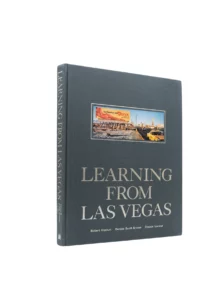
Learning from Las Vegas by Robert Venturi, Denis Scott Brown, and Steven Izenour, 1972. Museum purchase, REF: 2026.080.001
Sphere offers a contemporary example of a building whose form and entertainment concept developed together. Its spherical structure creates an instantly recognizable landmark, while its exterior “Exosphere” is a programmable 580,000-square-foot LED surface that can transform the building into a giant digital canvas.
Thanks to its steeply tiered seating and immersive screen were designed to give audiences a strong visual and acoustic experience throughout the venue.
2. Designers Plan Around the Arrival
Entertainment begins long before the scheduled show, dinner or hotel stay, which means that the building itself is even more important.
Architects and urban designers can use pathways, landscaping, lighting, framed views and changes in scale to create anticipation. Instead of treating circulation as the shortest route between two points, they design it as a sequence: glimpse, approach, reveal and arrival.
The Park, located between New York-New York and Park MGM, demonstrates this principle well. The outdoor district functions as both a social gathering space and a gateway to T-Mobile Arena, bringing together desert-adapted landscaping, public art, patios, restaurants and entertainment along the route to the venue. The design reimagined the pedestrian experience along the Strip and created direct connections between the surrounding resorts and arena. You can read more about their approach in their press release here.
These elements serve practical purposes, including moving crowds and connecting destinations, but they also turn the walk into part of the experience.
3. The Performance Can Determine the Architecture
For some entertainment venues, architects design a flexible room and performers adapt their productions to it. But some entertainment venues in Las Vegas have embraced the opposite model and design a permanent theater around the physical demands of a specific show.
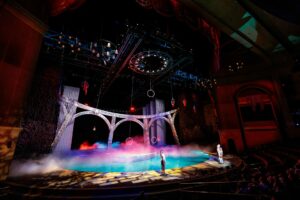
The Bellagio Theatre was developed around Cirque du Soleil’s aquatic production “O”. Its European opera-house-inspired interior surrounds an aquatic stage: a 25-foot-deep pool containing 1.5 million gallons of water and equipped with four hydraulic lifts.
The Bellagio Theatre is an example of how the show itself can influence the architecture and design. The building must accommodate water, aerial movement, performers, rigging, backstage circulation, and complex technical operations. Architecture and production design become difficult to separate because each depends on the other.
4. Experiential Architecture Goes Beyond What Meets the Eye
People experience architecture through sound, temperature, texture, movement and spatial awareness, as well as sight, and no city understands this as well as the Entertainment Capital of the World. The city’s entertainment-focused designs take into account all of these sensory layers.
The Colosseum at Caesars Palace shows this in action because it takes into account much more than just the design of the theater. The venue has received a multimillion-dollar acoustic enhancement, along with upgraded lighting and custom retractable seating. These systems help the theater adapt to different productions while considering sight, sound, and the overall experience.
In experiential architecture, teams must think about all the senses that they want guests to engage with.
5. The Signs Can Be Part of the Experience
When you think of a sign for a building, you likely think of just a boring facade that shows you where the entrance is. But in a city centered around entertainment, a building’s sign can also be part of the experience.
While not exactly a traditional sign, Fremont Street Experience shows how modern technology can create a huge programmable ceiling to create a shared entertainment experience. Its overhead canopy stretches 1,375 feet along the pedestrian mall and presents large-scale LED visuals above visitors. This is more than signage: it turns the architecture above the street into part of the entertainment itself.
Las Vegas signs have long been part of the city’s architectural experience, and we talk about that a lot over at The Neon Museum. Throughout the Museum, you can see how designers used typography, color, animation and distinctive forms to attract attention, communicate identity and turn businesses into landmarks.
Architecture as an Experience, Not Just a Container
Entertainment-focused architecture still has to perform all the fundamental jobs of a building, like moving people from point A to point B efficiently, accommodating guests, and supporting daily operations. But what’s different with experiential design is that the building can also create a feeling, tell a story or become the backdrop for lasting memories
Because there are so many experiential designs in Las Vegas, it’s the perfect place to study this kind of architecture. Duck Duck Shed brings architects, designers, historians, entertainers, and Las Vegas enthusiasts together to explore the decisions behind the city’s built environment.
The 2026 event takes place October 23–26 and includes tours, panels, exhibitions and behind-the-scenes experiences focused on Las Vegas architecture, design, entertainment and culture. Get your tickets now!
Sources
Architecture / theory
- Venturi, Robert; Denise Scott Brown; Steven Izenour. Learning from Las Vegas. MIT Press, 1972; revised edition, 1977.
Primary source for the “duck” and “decorated shed” concepts. - Duck Duck Shed. “Duck vs. Decorated Shed Through the Lens of Vegas Resorts.” September 9, 2025.
Duck vs. Decorated Shed Through the Lens of Vegas Resorts
Sphere
- Sphere Entertainment Co. “Hello World! Sphere Illuminates Entire Exterior for the First Time.” July 5, 2023.
Sphere Entertainment — Exosphere announcement - Sphere Entertainment Co. “Sphere Reveals Winners of XO Student Design Challenge and Debuts Their Artwork on the Exosphere.”
Sphere Entertainment — Exosphere specifications - Populous. “Sphere.”
Populous — Sphere project profile
The Park / T-Mobile Arena
- Populous. “T-Mobile Arena.”
Populous — T-Mobile Arena project profile - Cooper Robertson. “The Park.”
Cooper Robertson — The Park project profile - MGM Resorts International. “Las Vegas Strip’s First Park Debuts Today.” April 4, 2016.
MGM Resorts — The Park announcement - T-Mobile Arena. “The Neighborhood.”
T-Mobile Arena — The Park
“O” at Bellagio
- Bellagio / MGM Resorts. “O Show FAQs.”
Bellagio — O by Cirque du Soleil FAQs - Diving into the Abyss: Scenography for Contemporary Aquatic Theatres. Theatre and Performance Design, 2015.
Academic source documenting the O Theatre’s pool, hydraulic lifts and technical infrastructure.
The Colosseum
- Caesars Entertainment. “Caesars Entertainment Officially Relaunches The Colosseum in Las Vegas with Significant Technical and Guest Enhancements.” September 9, 2019.
Caesars Entertainment — Colosseum renovation - Scéno Plus. “The Colosseum Revamp.”
Documents the $15 million renovation and its architectural, theatrical, acoustical and technical scope. - Meyer Sound. “The Colosseum at Caesars Palace.” December 12, 2019.
Meyer Sound — The Colosseum
Fremont Street Experience
- Fremont Street Experience. “Viva Vision: The World’s Largest LED Canopy Screen.”
Fremont Street Experience — Viva Vision - Fremont Street Experience. “The Canopy.”
Fremont Street Experience — The Canopy
Duck Duck Shed 2026
- Duck Duck Shed. “2026 Program Offerings.”
Confirms October 23–26, 2026 programming and the range of tours, panels, exhibitions and behind-the-scenes experiences. - Duck Duck Shed. Official website.
Confirms the event’s positioning as a citywide cultural experience focused on Las Vegas architecture, design and the city’s evolving built environment.